Every year I struggled with accurately representing skin tones while crafting in my classroom. I wanted my students to feel good about the crafts they created but most of their artwork didn't look like them because their skin tones could not be represented with the teaching resources or supplies I had. I work in one of the most diverse populations in the United States – Houston, Texas. My classes featured a wide variety skin tones, however our resource pile only contained manila and dark brown paper, and peach and brown markers and crayons. My Lightbulb Moment: While I was working on my Kindness is the New Cool resource with my students, I had my "lightbulb moment". I wanted to color in some rosy cheeks but didn't have the proper colored marker; so I asked some of my colleagues if they had any blush and it worked out great. The paper creation had nice rosy cheeks but the skin tone color still didn't look right, and that's when it hit me... Why couldn't I use MAKE-UP for the skin tones? Make-up comes in SO MANY COLORS... All SKIN TONES! Awesome News: This was so exciting because I knew that brown eyeshadow would work great for the darker skin tones and it would also look smoother instead of … [Read more...]
Base Ten Clip Art to 100,000

Brand new product! Have you ever wished that you had base ten blocks that could represent larger numbers? I certainly have. When you use the manipulates that the school provides, you can only represent numbers in the thousands place, and then, only a few thousand or it gets to be too much. I'm excited to share with you today this brand new product I created. Introducing the Base Ten Clip Art Collection featuring six different colors and units up to the hundred-thousands – just think of the possibilities! Combining Traditional Base Ten Block By combining thousands cubes, I was able to create graphics/manipulatives to represent the TEN THOUSANDS PLACE and the HUNDRED THOUSANDS PLACE. 6 Different Colors There are 6 different colors including white for practice pages, plus you'll get all of the base ten clip art including ones/units, tens, hundreds, thousands, ten thousands and hundred thousands! Get Creative! Just think of the possibilities with this! Make your own manipulatives, task cards, homework, classwork, presentations... endless possibilites! Below is a set of task cards I made using this clip art. Click the links below to check them … [Read more...]
Adobe PDF Printing Tips For Teachers
Teachers use Adobe PDF to print almost everything. As a teacher, I know you probably think that you spend way too much money on ink and paper. I know I do, but, what are you gonna do? In this post, I've put together 8 Adobe PDF printing tips and tricks for saving money (and time) using the built-in print settings. Just a note, I probably wouldn't use some of these on graded work since I wouldn't want a student's lack of success to be associated with the size of the activity. Let's get to it! Tip #1: "I Have, Who Has?" Activities Usually, teachers create "I Have, Who Has" activities with 4 per page. But really, they don’t have to be that big. I have found that making them smaller, not only saves me ink, paper (and money), but the kids seem to LOVE the smaller cards. Check out the pics below of how you can turn an "I Have, Who Has?" activity into a station activity. After doing the "I Have, Who Has" activity with the entire class, it can be moved into a center/station. The cards are small that they won’t take up much space. Kids can line them up until they come to the last card. They love this! It can be done independently or with a partner/group. Below are the Adobe PDF print … [Read more...]
Making Inferences for Beginners

Getting Started with Making Inferences Making Inferences or Inferring is a skill that begins in the First Grade. This might sound a little crazy because the level of reading in grade one usually doesn't lend itself to inferring. So... at the beginning of first grade or until they have reached a higher reading level, students usually infer using pictures. This is good but as they progress, kids need to be able to infer or make inferences from text. When I started teaching my first graders to infer, I took a bit of a backwards approach or reverse inferring. I gave them the inference and asked them to provide me with the TEXT that supported it (text evidence). This worked out great. The "Making Inferences" Dialogue with Students It sounded something like this: "When I read this, the author snuck a little thought into my head. He said that it was Christmas." But... the word Christmas is nowhere in the text. So how did I get that idea? I would ask them to give me TEXT EVIDENCE for my thinking. They could do it every time! I love this backward approach for beginners. It is so EFFECTIVE and helps prepare them for the actual skill of giving the inference with text evidence. The "Making … [Read more...]
Geometry for Grades 1-3
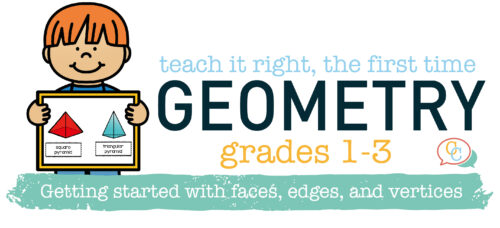
I taught Grade Three in Texas for 15 years and administered several Texas Assessments including the STAAR. Each year, teaching geometry to prepare for the assessment seemed a bit of a mystery, especially the three-dimensional shapes. As I taught the attributes of the 3-D shapes, I had unanswered questions and felt like I didn't have enough knowledge in this area; and the information given to me was lacking. Then as a 1st grade teacher, I also had the same questions and wanted to make sure I was teaching my first graders correctly. I decided to research a little deeper to see if I could find the answers this time. Today's post we're going to explore the questions I had and what answers I found for properly teaching Geometry in Grades 1-3. Grade 1-3 Geometry Questions: • Do cones, spheres and cylinders have faces, edges and vertices? If not, why do all of the worksheets ask questions about it? • Do you treat cones, spheres and cylinders as three-dimensional figures with polygons as faces? I always thought that 3-D shapes with curved edges should not have the same types of questions as the shapes without curved edges. I thought that asking for the faces, edges, and vertices on shapes with … [Read more...]
Base Ten: For Numbers Greater Than 1,000

Here's a twist on BASE TEN Clip Art that can help your students better understand the relationships between numbers. Sometimes teaching place value in greater numbers can be difficult because there is no way to model those larger numbers. Some kids really need to see that modeling but all kids can benefit from it. I decided to create clip art that could be used to model numbers over one thousand. Traditional Blocks Traditional Base Ten Blocks only come in one solid color. I created this set in two different colors making it easy for your students to count by ones or tens to see the total for each denomination. For example, your students can easily count by 1 to see the 10. They can also easily count by 10 to see the 100. Modeling Greater Numbers When modeling numbers greater than one thousand, having two colors can really simplify this difficult skill. Using the same idea from above, your students can count by 100 to see the 1,000, and, they can count by 1,000 to see the 10,000. Finally, your students can count by 10,000 to see the 100,000. This completely explains how BASE TEN Works! Discuss Base Ten As your students get into greater numbers, you can … [Read more...]